


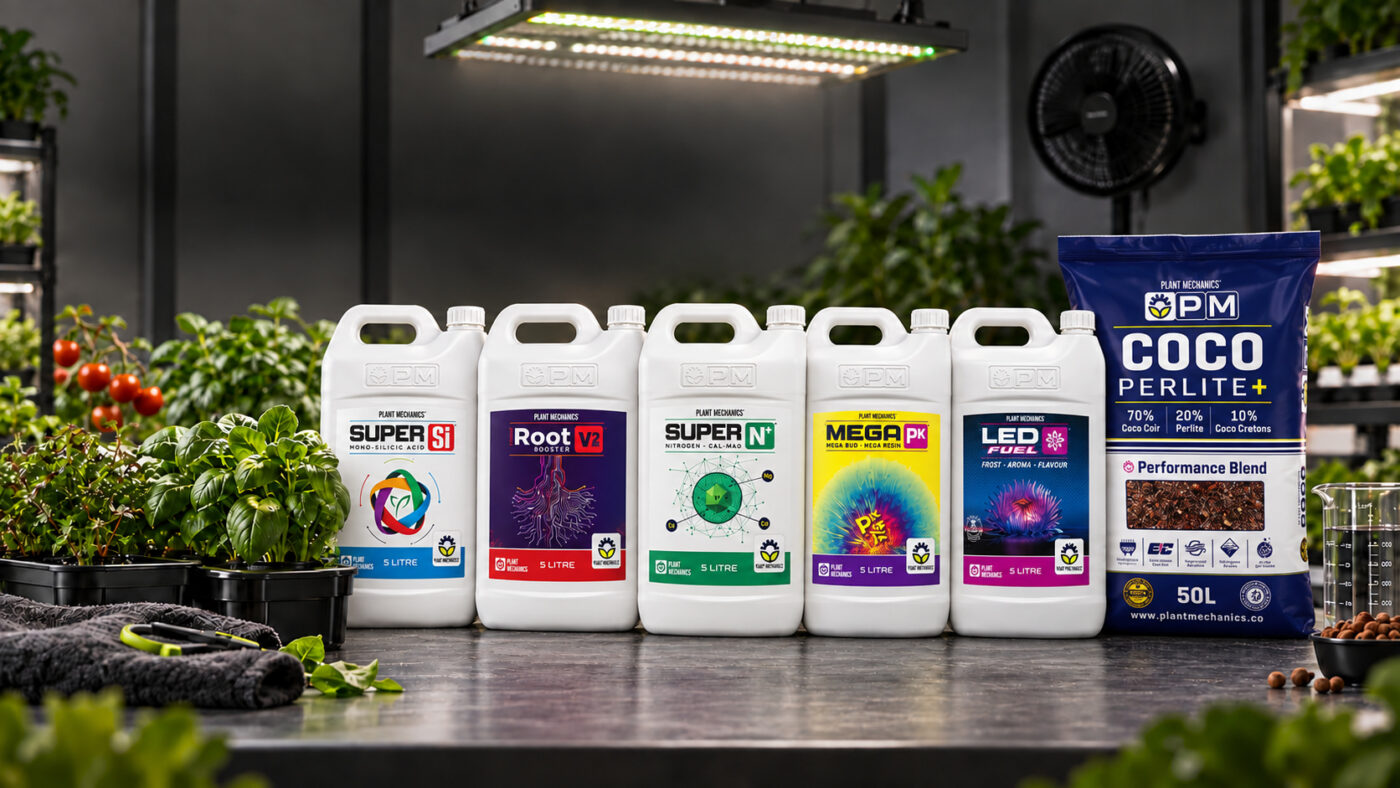
A nutrient range is easier to navigate when every product has a defined role. Start with the growing method and a suitable base nutrient, then consider whether any additional product addresses a specific need. Plant Mechanics products appear in the Stealth Garden catalogue across base nutrients, additives and growing media. This guide explains how to approach that selection without treating a longer shopping list as a better feeding programme. It is an editorial guide, not a claim about the company’s reasons for stocking the range or a guarantee of results.
Start with the substrate and crop
Write down the crop, development stage, growing media, irrigation method and source-water information before choosing bottles. These details determine which product instructions are relevant. Plant Mechanics COCO+ A&B is the catalogue’s coco-focused base nutrient option. The manufacturer’s website also identifies a base nutrient intended for coco-based growing. That gives a useful starting point for product selection, but it does not remove the need to check the current label and feed guide. Coco container size, composition and irrigation pattern affect the root environment, so nutrition and watering should be reviewed together rather than treated as separate recipes.
Keep the base programme coherent
The site also lists Plant Mechanics Full Spec Grow A&B and Plant Mechanics Full Spec Bloom A&B. These are distinct named formulations, not an instruction to use every base nutrient simultaneously. Confirm the intended crop, substrate and stage with current manufacturer guidance before choosing between programmes or changing stages. Do not blend complete base programmes at their full rates or infer a mixing ratio from the A&B name. Product formulations and instructions can change, so keep the label for the actual product in use available at the mixing station.
Give each additive a reason to be there
The catalogue includes Plant Mechanics Root Booster V2, Plant Mechanics Super Si and Plant Mechanics LED Fuel. Their availability does not mean every crop needs all three. Read the purpose, application method, timing and compatibility instructions for any proposed addition. Ask what observation or programme requirement supports its use, and how you will review the result. Avoid using an additive to cover an unresolved irrigation or root-zone problem. A wilted plant may need investigation of water delivery, drainage or roots rather than a stronger nutrient mixture. No additive should be presented as a guaranteed solution to an undiagnosed symptom.
Follow the actual mixing instructions
Use clean measuring tools and establish the real water volume in the reservoir. Follow the current manufacturer order of addition, including any product-specific requirements for additives. Keep concentrated nutrient components separate and mix each into water as directed; do not pour concentrates together. Read safety data sheets, use the required protective equipment and store products securely in labelled containers. Keep a written record of the batch, products and label-based amounts. This article deliberately provides no dosage table: a copied rate without the relevant product version, water conditions and crop context can create avoidable errors. Use the manufacturer’s current feed guide and obtain clarification when instructions do not match the planned system.
Check the finished solution and the root environment
Measure finished-solution pH and EC with maintained instruments and use crop- and programme-appropriate targets. EC indicates overall dissolved salt concentration, not the concentration of each individual nutrient. A familiar reading is therefore not proof that the nutritional balance is correct. In coco or another substrate, inspect actual irrigation delivery and drainage as well as the reservoir. UF/IFAS explains that media water-holding capacity and plant demand influence irrigation scheduling. Monitor the system you have instead of importing a fixed timetable from a different climate or container size. If readings change unexpectedly, confirm sampling and meter condition before adjusting the programme.
Review one decision at a time
A simple log should connect each feed to the crop stage, water source, mixing record and observations. Note when a product is introduced, changed or removed and why. Where practical, avoid changing several variables at once, because that makes the response difficult to interpret. For persistent symptoms, gather photographs and records and seek qualified crop advice rather than increasing every bottle. The practical value of a feeding routine is that it can be repeated, checked and improved. Start with a suitable base, use additional products deliberately and let measured conditions guide the next decision.
