

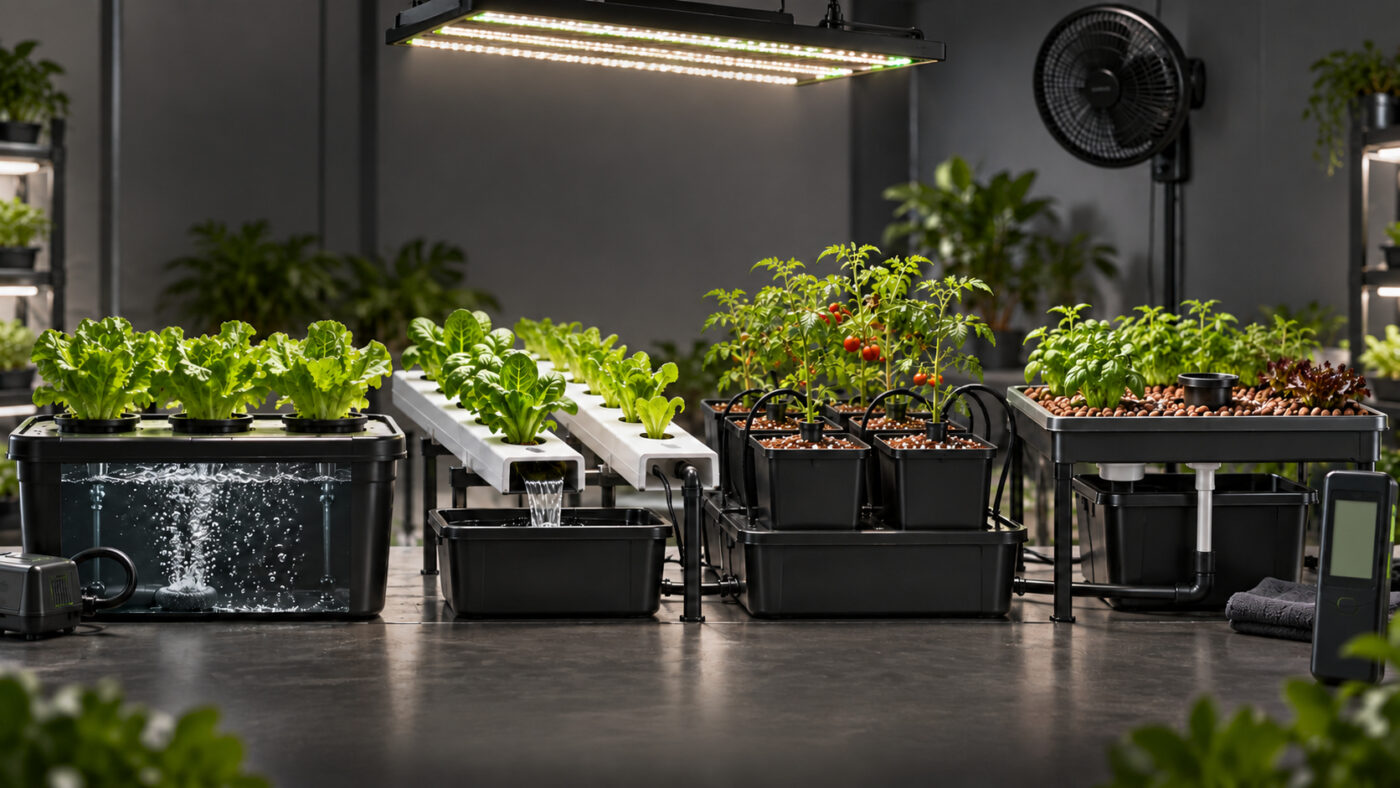
Choosing a hydroponic system is less about finding a universal winner and more about matching the root environment to your crop and daily routine. Lettuce, herbs and fruiting vegetables do not all need the same support, irrigation pattern or growing space. Start with the plants you want to grow, the water available and the time you can reliably spend checking equipment. Hydroponics means growing without soil; it can include a nutrient solution alone or a soilless substrate such as coco coir.
Deep water culture: roots in an aerated solution
In deep water culture, plant roots grow into a reservoir of nutrient solution. The plant is supported above the water, while aeration helps maintain oxygen around the roots. Access to the reservoir matters: you need to inspect roots, check solution conditions and service the equipment without disturbing the crop unnecessarily. A larger water volume can be less responsive to small changes than a tiny reservoir, but it also takes more effort to move and replace. Plan for safe draining before filling it. The VIVOSUN VGROW DWC KIT is a catalogue example to investigate for a compatible VGrow setup, not a universal conversion for every enclosure.
NFT: a flowing film through channels
Nutrient film technique uses a shallow flow of nutrient solution along channels. Roots can access both the solution and air within the channel. It is often associated with compact leafy crops, but channel dimensions, slope, root growth and plant support all influence whether a particular installation is suitable. The main practical question is what happens when flow stops. A blocked inlet or failed pump deserves a prompt response. Make channels accessible for inspection and cleaning, and check that established roots cannot obstruct the return path. Do not select a channel system solely because its footprint looks tidy.
Drip irrigation into coco or another substrate
Drip systems deliver nutrient solution to individual containers. Coco and other soilless media support roots and retain different amounts of water. That means a timer setting borrowed from another grower may be unsuitable even when both growers use drip irrigation. Container size, media composition, plant size and climate all matter. The VIVOSUN FLEXFEED DRIP IRRIGATION KIT FOR VGROW SMART is a specific catalogue option; confirm its intended equipment compatibility. For coco-based growing, Plant Mechanics COCO+ A&B is a base nutrient option to assess against its current label. Neither product removes the need to monitor actual water delivery and drainage.
Flood-and-drain: wetting followed by drainage
Flood-and-drain systems periodically fill a growing tray and then allow solution to drain away. The media must suit this wetting pattern, and the tray must drain reliably. Check both the normal drain and overflow arrangements before adding plants. A tray that drains poorly is not corrected simply by reducing nutrient strength. Leave enough reservoir capacity for the returning solution. Test what happens when the pump stops, rather than assuming the water level observed during operation is the highest level the reservoir will reach.
Choose by the checks you can maintain
Write down how each candidate system will be filled, sampled, drained and cleaned. Ask whether you can reach every connection and lift equipment safely. Decide who will respond to a stopped pump, a leak or a blocked emitter when you are away. Recirculating systems reuse solution, so changes in water level, dissolved salts and plant health need attention across the shared reservoir. Drain-to-waste arrangements need a responsible collection and disposal plan; never direct nutrient runoff into stormwater. Before planting, run a water-only commissioning test, observe a complete operating cycle and record any uneven delivery. Keep plugs and connections away from splash zones and have electrical supply and protection assessed by a licensed electrician. A manageable system with reliable checks is a better starting point than unnecessary complexity.
