


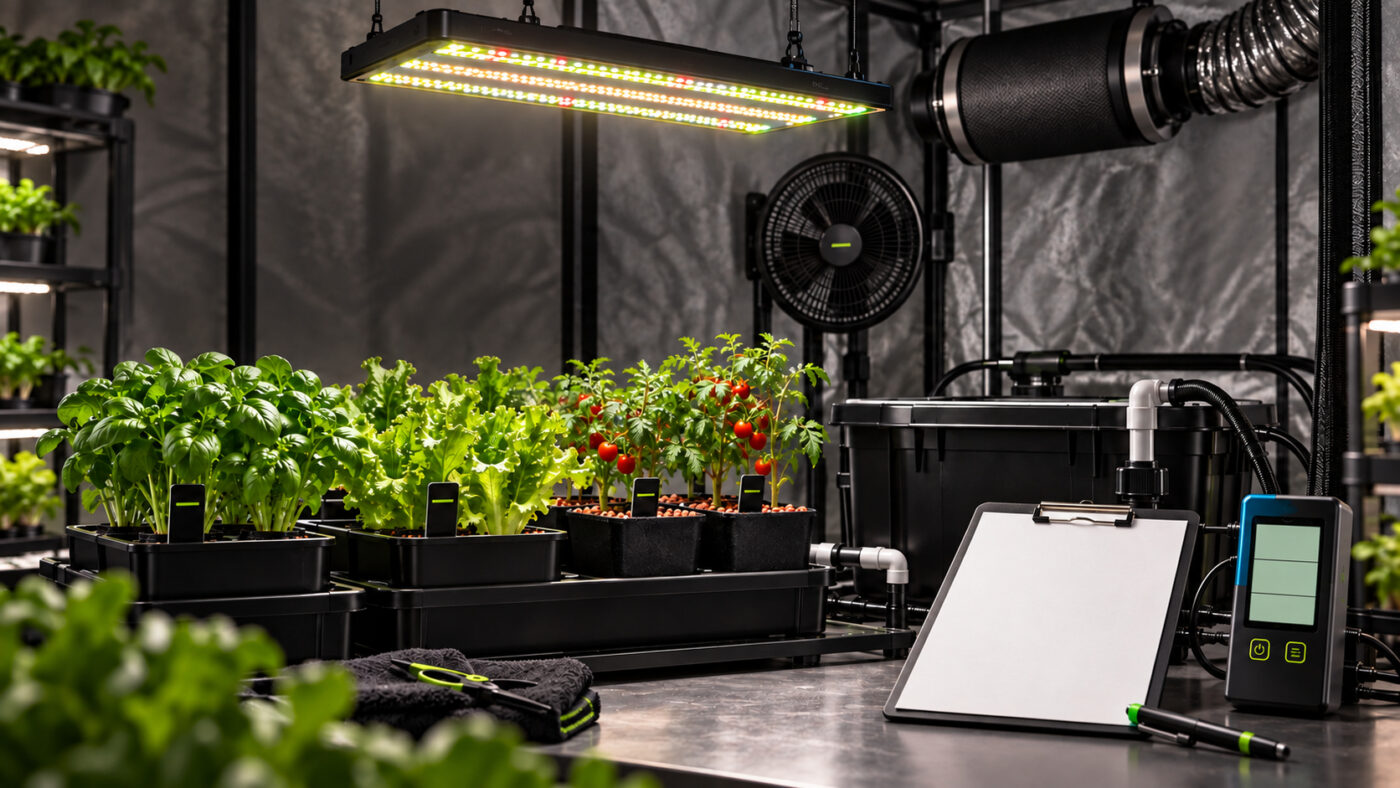
A grow room should be straightforward to inspect, clean and operate. Equipment choice matters, but the layout determines whether routine jobs remain easy once the plants are larger. Before buying or installing anything, sketch the growing area, working space, water route, drainage route and electrical access. Mark the fully grown crop dimensions rather than only the size of the seedlings. Use this checklist to identify questions that need resolving before the first planting.
Confirm that the space is suitable
Check permission to use the room and any applicable building, tenancy or business requirements. Look for existing moisture damage, inadequate ventilation and surfaces that are difficult to clean. Consider the weight of filled reservoirs and equipment; obtain professional advice where structural capacity is uncertain. Keep access and exit routes clear. Allow space to open doors, remove a reservoir lid and service pumps without moving an entire crop. Think about noise, exhaust placement and neighbouring rooms too. A room that works only when every component is perfectly positioned is difficult to maintain.
Separate electrical supply from water handling
Have a licensed electrician assess the supply, circuit loading and appropriate electrical protection before connecting the planned equipment. Do not assume that several available sockets represent independent circuits. Keep power boards, plugs and controllers away from reservoirs, drainage paths and splash zones, and follow each device’s installation instructions. Never daisy-chain power boards or improvise electrical connections. Identify a safe shutdown process and make sure everyone working in the room understands it. If equipment becomes wet or damaged, stop using it and obtain qualified advice rather than testing it while standing in water.
Plan lighting around the crop and working access
Choose lighting for the crop area and intended growing conditions, not just the largest wattage that fits. Review manufacturer guidance for suspension, clearances, dimming and compatible controls. Make sure suspension points are suitable for the load and that fixtures can be adjusted safely. The catalogue includes the HORTIVISION 720W PRODUCER LED; its presence is an option to assess, not a claim that every room needs that fixture. A HORTIVISION PAR METER + EXTENDABLE MEASUREMENT STICK is another listed option for checking light distribution. Confirm the measurement method and instrument instructions before using readings to change the setup.
Distinguish circulation from ventilation
A circulation fan moves air within the room; an extraction arrangement exchanges air with somewhere else. One does not automatically perform the other’s job. Plan the intake and exhaust routes, filter access, duct dimensions and controller location as a connected system. Avoid aiming strong continuous airflow at one group of plants while leaving others in a still corner. The VIVOSUN AEROWAVE D4 CLIP FAN is a catalogue circulation option. For extraction planning, the SIGILVENTUS EC MIXED FLOW INLINE FAN 150MM is a separate listed product. Confirm sizing, fittings and controller compatibility; matching brand names alone does not prove components work together.
Provide water containment and service access
Position the reservoir so it can be filled, sampled and drained without carrying water over electrical equipment. Secure tubing and check that outlets remain visible. Plan for leaks and for the water that returns when pumps stop. In substrate systems, avoid leaving containers sitting in collected drainage. Keep nutrient runoff out of stormwater and arrange suitable disposal. Label lines and valves clearly enough that another person can identify them. Provide a clean place for measuring equipment and store nutrient containers securely with their original labels intact.
Commission the room before planting
Run the irrigation system with water and inspect every connection through a complete cycle. Check actual delivery at several outlets rather than assuming equal flow. Test timer programmes and observe the system after a normal power-off and restart, following equipment instructions. Review temperature and humidity at representative plant positions through operating and non-lighting periods. Write down a baseline, emergency contacts and a daily inspection route. Keep spare maintenance items appropriate to the installed equipment, but do not use substitutes with unverified ratings. The goal is a room where faults are noticed early and routine checks are easy to complete.
